
Healthtech Expansion in Asia: A Practical Acceleration Model by VentureBlick and Seoul Bio Hub


Many healthcare startups are ready to expand. Far fewer are ready to enter a new market.
Between regulatory pathways, clinical workflows, and fragmented stakeholder landscapes, the gap between “interest” and “adoption” is where most expansion efforts stall.
This is the gap that VentureBlick and Seoul Bio Hub set out to address, through a cross-border healthtech expansion program called “Global Expansion Growth Acceleration”, designed not just for exposure, but for real market entry in Asia.
Rather than treating international expansion as a one-off milestone, the program was structured as a multi-phase journey. It combined upfront market validation with in-market execution, giving startups both the strategic clarity and the practical experience needed to operate in a new healthcare system.
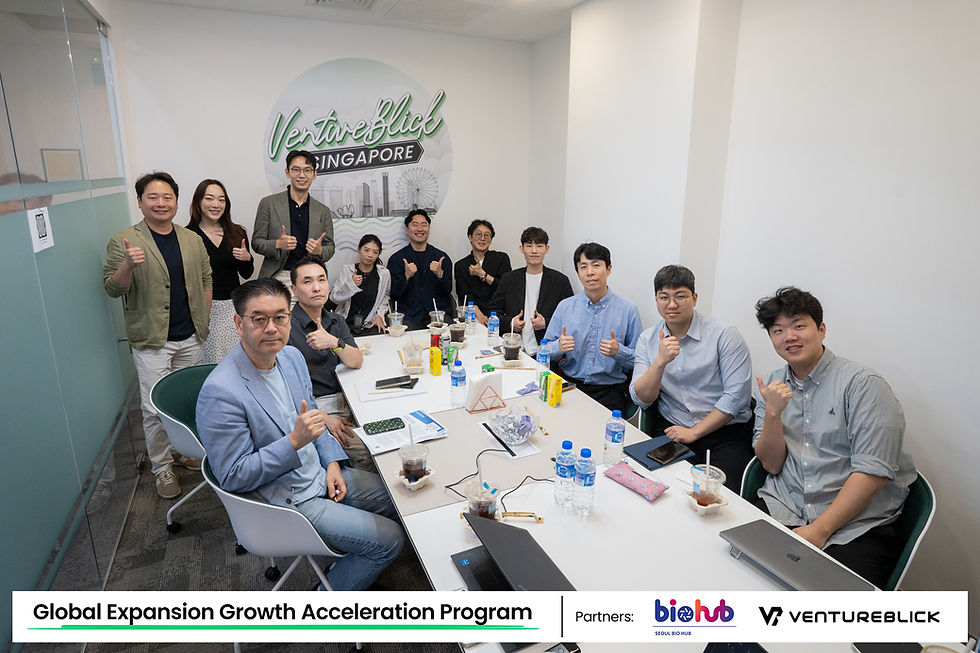
This program brought Korean healthcare startups into Singapore for a focused, on-the-ground immersion where ideas were tested, assumptions were challenged, and partnerships began to take shape.
At its core, this program was built on a simple premise: global expansion in healthcare is not a presentation exercise – it is an execution challenge.
Meet the Startups in This Cohort
The 2026 cohort brought together four Korean healthtech companies, each addressing different parts of the healthcare value chain, from diagnostics to devices to preventive care.
AIVIS: AI-powered histopathology software that supports faster and more accurate cancer diagnosis, helping clinicians detect breast cancer with greater confidence while uncovering new biomarkers for clinical decision-making.
Medicaretec: Developer of FlexDeb, the world’s first bendable blade with an integrated endoscope, designed to improve access and visibility in complex surgical spaces, particularly in ENT procedures.
neoAble: Smart cushions and mattresses that adjust pressure in real time using sensor-driven Aircells, improving blood flow and helping prevent pressure ulcers across care settings.
Team Elysium: Creator of Bodydot Fitness™, a next-generation body shape and exercise analysis solution powered by an AI model trained on 80,000 musculoskeletal cases and developed with medical professionals.

A Cross-Border Healthcare Accelerator Built for Market Entry
This program was designed for government agencies, innovation hubs, and ecosystem builders seeking more than visibility for their startups.
Instead of focusing on pitch refinement alone, it delivered a structured pathway from market understanding to market readiness, ensuring that startups engaged with new markets in a deliberate and informed way.
By combining research, validation, and in-market interaction, the program enabled startups to move beyond exploration and towards actionable entry strategies.
In collaboration with VentureBlick, Seoul Bio Hub was able to carry out the program in Singapore to support promising Korean biotech and healthcare startups in building a strong global presence. Through localized support and strategic partnerships spanning market validation to commercialization, the program tangible outcomes and sustainable global growth.

From Market Research to Market Readiness
Before entering Singapore, each startup underwent a tailored market validation phase.
This included a focused assessment of regulatory pathways, competitive positioning, and commercialization strategies across Singapore and Southeast Asia.
More importantly, it reframed how founders think about expansion. Instead of asking “Where can we go?”, the question became “Where do we fit and what needs to change?”
By the time startups arrived in Singapore, they were not starting from scratch. They were entering the market with hypotheses, ready to test, refine, and adapt them in real-world settings.


In-Market Execution: Where Strategy Meets Reality
The Singapore immersion was where the program came to life.
As part of a broader multi-month acceleration program, the three-day Singapore immersion was designed to translate strategy into real-world validation.
Startups engaged with clinicians and ecosystem partners across Singapore through curated sessions spanning public hospitals, private clinics and long-term care settings, including organizations such as the National Healthcare Group, Centre for MedTech & Innovations (CMTi) co11ab Novena, SIT Healthy Living Lab, Rehabilitation Research Institute of Singapore (RRIS), and PanCare Medical’s Transitional Care Facility.
They demonstrated their products in these environments, receiving immediate feedback on usability, workflow integration, and clinical relevance. These are insights that cannot be replicated through desk research or remote calls.
Alongside clinical engagement, founders participated in business coaching and mentor sessions, pitch marketing workshops, and targeted meetings with potential collaborators. These discussions were grounded in actual product use cases and current market conditions.
This created a continuous feedback loop: ideas are tested, challenged, and refined in real time.

Clinician-Led Validation as a Core Differentiator
A defining feature of VentureBlick’s accelerator model is its emphasis on clinician-led validation.
Through its global network of over 6,500 clinicians and domain experts, the program connected startups with advisors who understand both the clinical and operational realities of healthcare systems.
These experts do more than provide feedback. They interrogate assumptions, assess practical fit, and highlight barriers to adoption, whether in workflow integration, patient pathways, or decision-making processes.
As a result, startups gain a clearer understanding not just of whether their solution works, but whether it works in context.

Building Real Connections Across the Ecosystem
Equally important is the depth of ecosystem engagement.
Startups interacted with stakeholders across the healthcare value chain, from clinicians and care providers to innovation platforms and potential commercial partners.
This breadth allowed founders to see how different parts of the system connect and where their solution can realistically fit.
Rather than a series of introductions, these interactions formed the basis of early relationships that can evolve into pilots, partnerships, and market entry pathways.
Each meeting was curated and pre-briefed, ensuring stakeholders engaged with clear context and aligned expectation, allowing discussions to move quickly beyond introductions into meaningful, outcome-focused conversations.
The Singapore segment culminated in an Unboxing Day event, where over 50 clinicians, investors, corporates, and ecosystem partners gathered to engage with the startups in a more open setting. Beyond structured meetings, this created space for deeper conversations where stakeholders could see the products in action, ask practical questions, and explore potential collaborations. It marked a natural progression from curated engagements to broader ecosystem exposure, reinforcing connections and accelerating momentum towards real partnerships.

A Practical Alternative to Traditional Accelerator Models
Many accelerator programs provide access. Fewer provide clarity.
By focusing on validation, execution, and real-world engagement, this model offers a more practical alternative, particularly for healthcare, where adoption is complex and context-dependent.
Startups leave the program with:
a more grounded view of the market
clearer regulatory and commercial pathways
refined positioning based on real feedback
and early signals of partnership or pilot opportunities
For government agencies and ecosystem partners, this translates into stronger outcomes and more effective use of resources.

A Repeatable Model for Cross-Border Healthtech Expansion
The collaboration between Seoul Bio Hub and VentureBlick reflects a broader shift in how healthcare innovation scales globally.
Success is no longer defined by technology alone, but by how effectively that technology is validated, adapted, and integrated into real healthcare systems.
This program offers a repeatable model for supporting startups as they expand beyond their home markets.
“It has been a very positive experience. In particular, we were able to meet many ENT doctors in Singapore who are typically difficult for us to access from Korea, and we are leaving with a great deal of valuable feedback.” Hanyong Chun, Founder & CEO, Medicaretech
“The most impressive meeting was with a KOL from SingHealth. He shared very honest feedback on our product and how we should approach the Singapore market, which will help us refine our go-to-market strategy.” Chule Park, Global BD Manager, AIVIS
“The meetings were tightly scheduled, and that meant we were able to meet more actual potential users of our product than expected, which was very helpful.” Seong Su Joo, Co-Founder & CMO, Team Elysium
From Interest to Entry
Many startups express interest in new markets. Few successfully enter them.
Bridging that gap requires more than access. It requires structure, validation, and real engagement on the ground.
As healthcare innovation becomes increasingly global, the ability to move from intention to execution will define which programs and which startups ultimately succeed.


Comments